Investment (CAPEX) and running costs (OPEX)
They are defined in 5 · Economics.
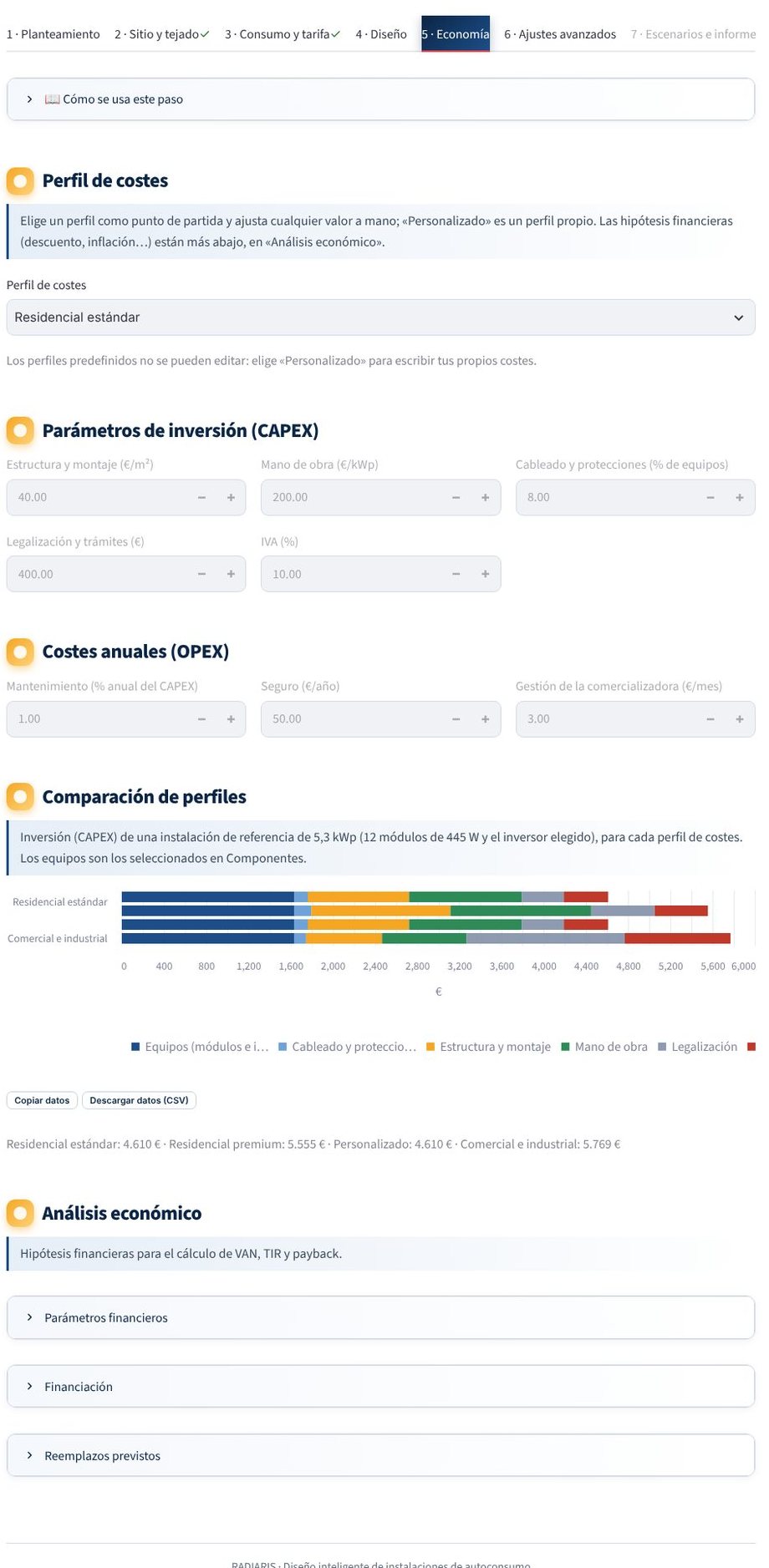
Cost profile
Choose a starting point and adjust each item:
| Profile | Structure (€/m²) | Cabling and protections | Labour (€/kWp) | Permits (€) | VAT |
|---|---|---|---|---|---|
| Standard residential | 40 | 8 % | 200 | 400 | 10 % |
| Premium residential | 55 | 10 % | 250 | 600 | 10 % |
| Commercial / industrial | 30 | 7 % | 150 | 1.500 | 21 % |
| Custom | 40 | 8 % | 200 | 400 | 10 % |
These are indicative values for Spain (2025 reference). Replace them with your real costs before presenting an offer.
CAPEX
CAPEX = (Modules + Inverters + Batteries + Optimizers
         + Cabling and protections + Mounting structure + Labour + Permits) × (1 + VAT)
| Item | How it is calculated |
|---|---|
| Modules | Unit price × number of modules |
| Inverters | Sum of the price of each inverter |
| Batteries | Unit price × number of batteries |
| Optimizers | Price per unit (€35 by default) × modules, if any |
| Cabling and protections | Percentage of the electrical cost (modules + inverters + batteries + optimizers) |
| Structure and mounting | €/m² × area occupied by the modules |
| Labour | €/kWp × peak power |
| Permits | Fixed amount |
| VAT | Percentage of the total excluding VAT |
The breakdown is shown in the report and in the offer.
OPEX (annual costs)
| Item | Default |
|---|---|
| Maintenance | 1 % of CAPEX per year |
| Insurance | €50/year |
| Management with the electricity retailer | €3/month |
OPEX rises every year with cost inflation (2 % by default).
Equipment prices
Module and inverter prices come from the catalogue, and you can replace them with your own unit price (useful for imported components, which carry no price).
Is something missing or wrong? Write to us at hola@radiaris.com. Last reviewed: 26 October 2026.