Tariff types
The tariff sets the prices used to value the self-consumption savings (what you stop buying) and the export income (what you sell). Off-grid installations have no tariff.
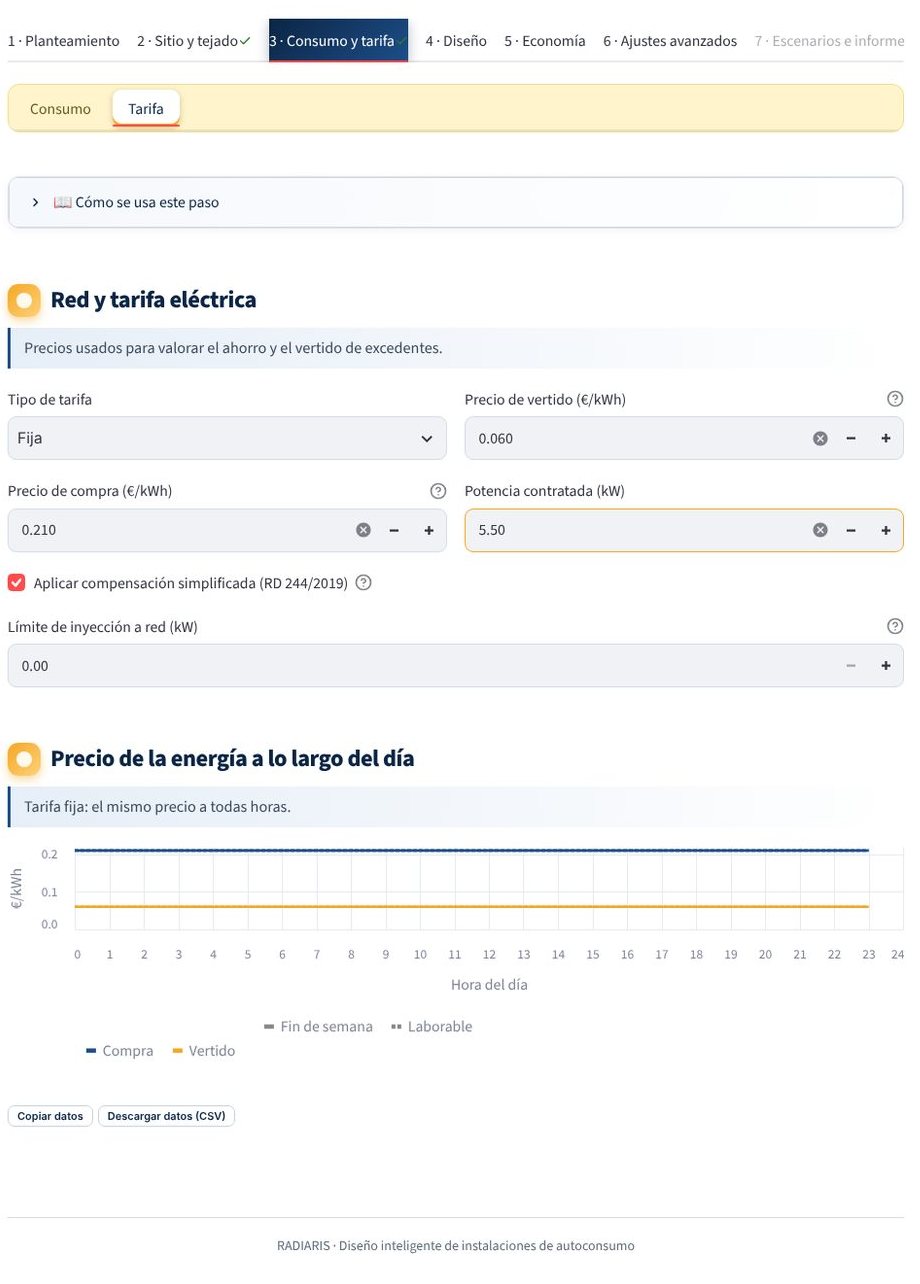
Fixed
A purchase price and an export price that are constant all year. It is the simplest and the one used for most offers.
| Parameter | Example value |
|---|---|
| Purchase price (€/kWh) | 0,21 |
| Export price (€/kWh) | 0,06 |
| Contracted power (kW) | 5,5 |
Indexed
The purchase price follows the wholesale market (pool) plus network tolls and charges. In Radiaris it is an approximation with editable average values:
| Component | Default |
|---|---|
| Average pool (€/kWh) | 0,06 |
| Network tolls (€/kWh) | 0,07 |
| Charges (€/kWh) | 0,05 |
Approximation
The engine does not query real hourly prices from OMIE or ESIOS: it uses the values you enter. If you need another average price, edit the three components.
PVPC 2.0TD
Spanish regulated tariff with three periods:
| Period | Schedule | Default price (€/kWh) |
|---|---|---|
| Off-peak | From 0:00 to 8:00 every day, and all day at weekends | 0,08 |
| Peak | Weekdays from 10:00 to 14:00 and from 18:00 to 22:00 | 0,25 |
| Mid-peak | The rest | 0,15 |
All prices and the hours of each period are editable in «PVPC and indexed settings». The export is valued as a percentage of the mid-peak price (editable).
Contracted power and power term
The contracted power (kW) and the power term (by default €0.05/kW·day) determine the annual fixed cost of the tariff. It does not change the energy savings, but it appears as a fixed cost.
Which price to enter
- Use the all-inclusive average price (energy + tolls + charges + taxes) from the client's bill for purchases.
- For export, the compensation price paid by their electricity retailer.
- Remember that VAT and the electricity tax are part of the effective price that is saved.
Next: Compensation and export.