Automatic topology
In automatic mode the engine decides the array configuration. It is enabled with Design mode → Automatic in step 4.
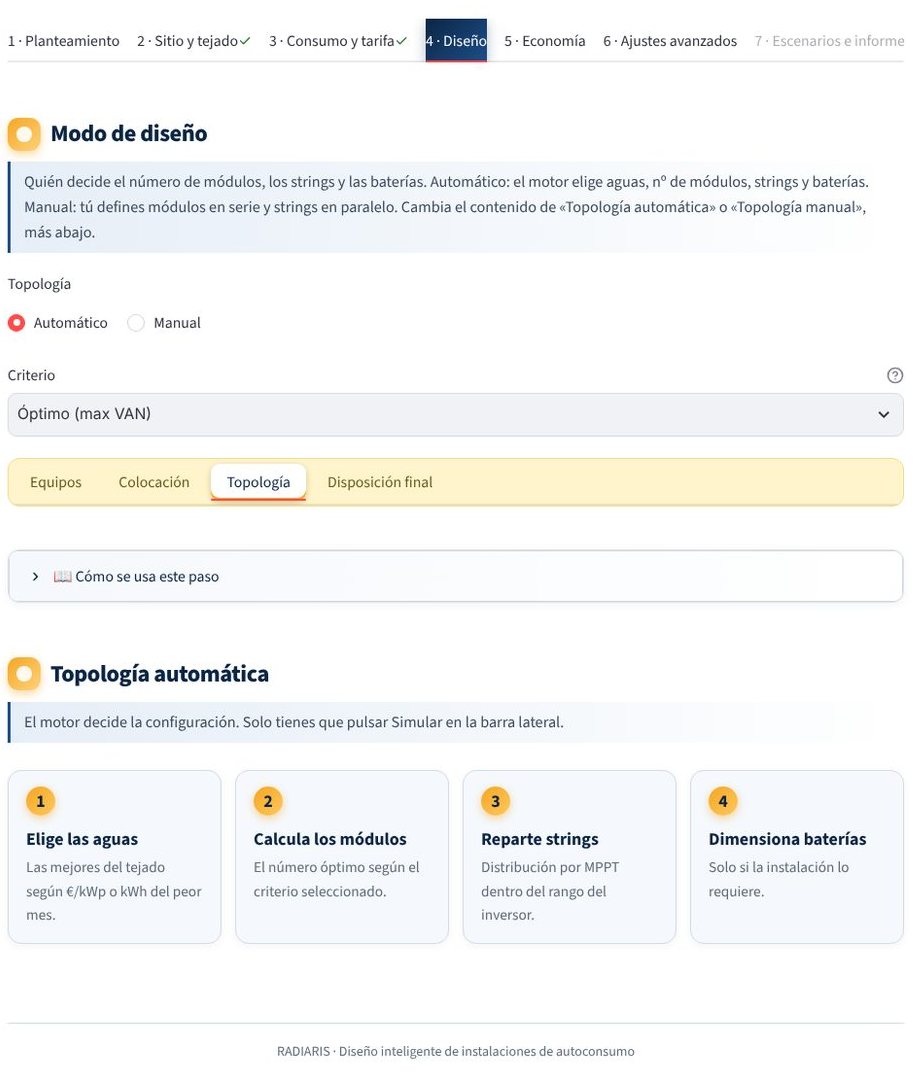
What it decides
- Which roof planes to use (up to the number of MPPT inputs of the inverter).
- How many modules to put on each one.
- How to group them into strings (modules in series × strings in parallel) while respecting the electrical range of the inverter.
- How many batteries to install, if there is a battery.
How it searches
- It ranks the planes by merit. According to the economic-energy criterion (and, off-grid, the kWh of the worst month). It discards planes where not even a minimum string fits.
- It calculates the legal range of modules: the minimum and maximum that simultaneously satisfy the geometry (what physically fits on each plane), the inverter voltages, the currents of each MPPT and the DC/AC ratio.
- It sweeps the configurations within that range, simulating each one and assessing its economics.
- It tries subsets of planes (the best 1, 2, … up to the number of MPPTs), moving on to the next only if the geometry limits the result.
- It chooses according to the selected criterion.
Criteria
| Criterion | What it chooses |
|---|---|
| Optimal (default) | The configuration with the maximum NPV |
| Conservative | The one with the shortest payback among those with a positive NPV |
| Ambitious | The one with the highest annual production among those with a positive NPV |
| Technical (off-grid) | Covers the consumption of the worst month with the stated days of autonomy |
Automatic batteries
The engine tries from 1 up to a configurable maximum number of batteries (4 by default) and chooses according to the criterion. It can also suggest a capacity based on your night-time consumption (average daily night-time consumption with a 20 % margin), useful as a starting point.
Off-grid
It is sized on technical criteria: batteries for the days of autonomy and modules to cover the consumption of the worst month, with a safety margin and overall efficiency (see Installation types). If the roof or the inverter limit the power, the warning tells you how many modules would be needed.
When it finds no solution
The engine tells you why. Common cases:
- Fewer modules fit on the roof than the minimum in series the inverter needs to reach its minimum start-up voltage. Enlarge the roof or choose an inverter with a lower minimum MPPT voltage.
- There is no valid position left because the outline, obstacles and shading take up the whole roof. Raise the maximum allowed shading loss, reduce the edge margin or turn off automatic placement.
Speed
The engine caches repeated simulations so that small changes (for example, to prices) do not force everything to be recalculated.